
Ten Years After
Ten years ago, in June 2013 Encounters and Engagements a meeting about Medical Anthropology began in Tarragona, Spain. Those words ccame from the openening.
Last night I dreamt I went back thirty years ago to December 1982. We were in the closing event of the First meeting in medical anthropology, and
“Without no doubt, today 17th December 1982, Saint Lazar, is an historical milestone and a crucial day in the starting point of medical anthropology. A date to be placed in the annals of the history that someone will write in the future. We are the witnesses of this event, where more than the words we could say to day, the point is the Fact we are today together”
Jesus was right; I recover his words to open this meeting, about 550 participants, from 51 countries and here a special mention for our colleagues from Oceania, The Pacific Islands, Australia and New Zealand coming from our antipodes. In 2043, may be some of you, now young students and scholars may remember this event in similar terms in another meeting like this one, or maybe not. This should measure the success or the failure of this meeting, it should a starting point or a dead end. All depends on all us.
In September 2011 Viola Hörbst and Pino Schirripa, in Lisbon, asked me if the Tarragona medical anthropologists could organize a shared meeting between the SMA/AAA and the MAN/EASA. I beg them to wait. Our entire group here and there considered that this was something we have to do to be coherent with three decades working to weave ties with Italy, France, Portugal, the Northern Europe and Latin America. Nevertheless, I can understand the surprise of some of you overseas about the idea to travel to a so remote city, Tarragona….
Where is it? Google it!
Who are these guys?
Strange words, URV something, DAFITS, REDAM, Spain, Catalonia, the Barça football (soccer) team. Texts in Spanish, but also in strange languages as Catalan, Basque, Galicia. Tarragona is a 120000 people city with an university with a impossible to spell Rovira i Virgili- , roman ruins founded a century after Hippocrates dead, in a Far-West province of the Roman empire, to day a peripheral place in a global world. Here is the paradox. During three days Tarragona has muted to be the hauptstadt of medical anthropology. Friday afternoon, like Cinderella we may became another time a quiet and peaceful city looking to the future. Our purpose, dear colleagues, after this meeting is that you remember forever this city, and this event, ¡ we accepted such challenge because we have work together and prepared more than three decades to deserve it and because we are very proud of our students. Medical anthropology is a humble branch within URV, and most of the Tarragona citizens ignore we exist, like most of you six months ago. This is the reason why the conference is also open to the city: our multimedia stream in the Auditorium, christened for the event as Theatre Lluis Mallart to honour the founder of Catalan medical anthropology, the workshops, the castells exhibition, the book exhibition: The Rise of medical anthropology in our library.
We have organized this event with love. To do these things without good feelings is impossible. This scarcely scholar expression depicts, however the enthusiasm of our Steering committee: Anita, Viola, Liz, Carolyn, Andrew, a brotherhood from Idaho to the Northern England close to Borders and Lothian, from Texas to the Netherlands, from Bayern and Lisbon to Catalonia. Our multiplex conferences on Mondays or Tuesday afternoon became the pleasant experience of a group of friends, with Liz cats walking over her desk and saying us good morning or good afternoon in Mountain time or CET time…
It is time of acknowledgements. Let me begin with the SMA/AAA, the MAN and MAYS/EASA who trusted in the Universitat Rovira i Virgili. The three institutions government boards have collaborated with growing enthusiasm to make possible the event. Thanks to Doug Feldman (SMA), Susan Narotzki, former president of EASA, and Francesc Xavier Grau the president of our university. Next month the URV will fund the Medical Anthropology Research Centre, the tool we need o build a large interdisciplinary community of research in this university, in some way the recognition by our university of the role that medical anthropology play in our common project.
Fundació URV and particularly Charo Romano, my three decades old friend, Susana Paxton, Jose Luis Galiano and Manfred Egbe and today Laura with tenacity and workalcolism managed the kitchen of the meeting and guided our sailing to our destiny.
I am a faculty member of the DAFITS since September 1977. Our faculty is the responsible of the development of medical anthropology in Spain. At the beginning we are five – Dolors, Juanjo, Joan and Oriol -, to develop Anthropology here, now the medical anthropology staff Oriol, Angel, Mabel Susan Digiacomo and our collegues in Nursing School: Lina, Maria Antonia Martorell, Maria Jesus Montes, Martin Correa, Serena Brigidi and Josep Barceló. However, we would be nothing without our students. Their work, their commitment has obliged us to be as good as possible, we have learned with them they are very present, and without them it should be impossible to develop this meeting. At last but not at list the DAFITS officials Nuria, Pedro, Laura, Natalia, Marija; Laia thank you.
The Library of the Campus helped us to develop the exhibition with Eva, Elisa, Silvia and Isabella as co-curators: The rise of medical anthropology: a genealogy of a discipline through books and journals show 160 documents recalling the development of medical anthropology. Our colleagues offered nine workshops. The Oficina Logistica of the campus work hard to offer us the Campus in the best conditions, The Facultat de Lletres, The Wenner-Gren foundation, the Department of Economy of the GdC have offered financial support, the Ajuntament y Diputació de Tarragona logistic stuff, and the oil company REPSOL finances the castells exhibition. Castells are a mix between encounters and commitment: people of all ages and conditions mixed in a no venal activity, fighting in a common effort to develop an art.
Let me to finish speaking with a personal touch. There is a person, who cannot be here, who is the very ultimate responsible of this meeting.. She encouraged, as no one other the dialog in European medical anthropology North-South, East West.. All began a clear day of spring, fifteen years ago when I arrived to Zeist, in the Netherlands, to the Medical Anthropology at Home first meeting, I crossed the main lobby. I address myself politely, to a Dutch not very tall woman, in her middle age, brown hairs, with an eternal cigarette in her hands:

Dr. Van Dongen , I presume…
Thanks always, Els….
&EDear colleagues:
At the beginning of the organization of this event, we feel that there should be a place to do a humble homage to our founders. 30 years ago, here in Tarragona we did. We recall Pius Font i Quer the great ethno botanist that studied the entire natural environment of Catalonia and include, in his plants and trees records, a positivistic ethnography on their popular use.
Recover the memory of all the medical anthropology founders is impossible. As curators of the exhibition The rise of medical anthropology, you can watch in the Campus Library (CRAI) we knew the difficulty to get books or publications of the ancestors of medical anthropologies who wrote in minority languages, in Slavic and Scandinavian languages, and on the main Asian ones. The 22 million documents that our Library catalogue preserves offer limited resources in those languages.
Who are our founders? It not easy to define them in a large historical perspective. Nevertheless, we thought about two generations born before the end of the Second World War and whose work is on the basis of this meeting. Some are globally known, others are known in their linguistic domains. For English speaking people Rivers should be a reference, so are in Latin languages Ernesto de Martino or Gonzalo Aguirre Beltran. After the II World war the panorama became more and more complex with the development of national an regional genealogies in medical anthropologies in different languages.
All the presents we have learn from them and most of us are here because of them. They are few dozens around the World, they wrote or are writing in a lot of different languages, and most are not known outside their linguistic borders. On designing the opening ceremony we feel that we can in a symbolical way those generations choosing two of them.

On one hand, Susan Reynolds-Whyte, an American working in Denmark and Africa for decades and in th other hand, Lluis Mallart, a Catalan whose career developed in France, who has written mainly in French and in Catalan, with some Spanish production. Anita Hardon will introduce you Susan later, let me to speak about Lluis Mallart, one of the founders of French medical anthropology and the founder of Catalan medical anthropology.
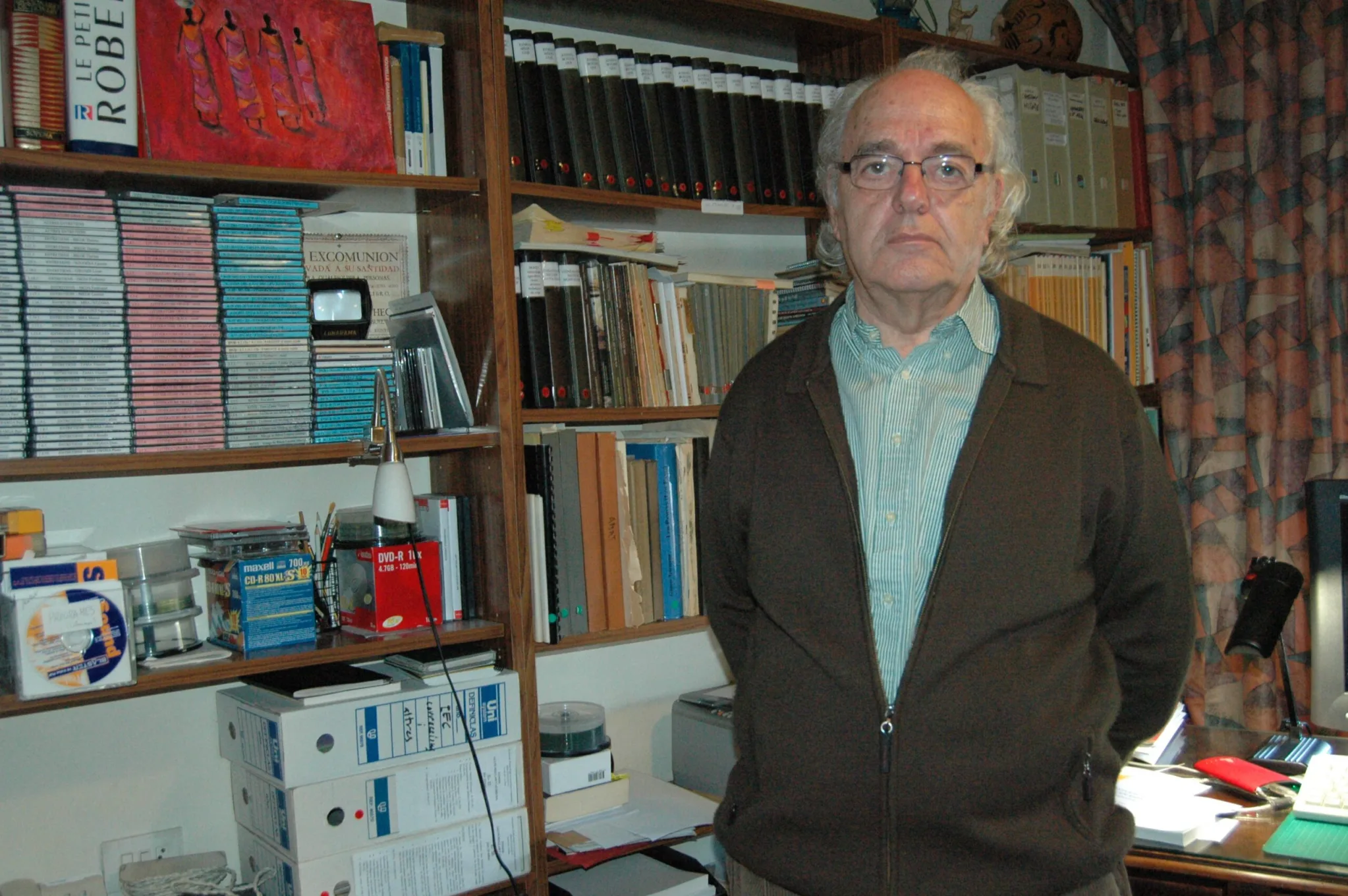
Lluis Mallart was born in Barcelona few years before the Spanish civil war. In their teen age the influence of some Jesuit missionaries coming from India led him to become a Roman Catholic priest and a missionary in Cameroon just after the independence. He went there to convert the people, he was converted himself by anthropology. Jesuits have been great ethnographers since the foundation of the order. Lluis Mallart is a great ethnographer after fifty years doing ethnography in South Cameroon. An entire life who allow him books and papers most of them in French, and in a very beautiful Catalan. He is still working, and a few weeks ago he send me a book to be published about an ewondo epic poem and another project related to material culture. His ethnography is carefully preserved in the University of Nanterre. It is a big collection of field notes, diaries, sound ethnography, a collection that is a fundamental source of ethnographic and historical data covering more than half a century for the knowledge of Southern Cameroon cultures.
Lluis Mallart wrote an important part of his work in French. It was present in the foundational meetings of French medical anthropology, and he was present in the foundation of Catalan and Spanish medical anthropology in 1982. For my generation, in Catalonia, Mallart became the best reference of the classical professional model in Anthropology. We had to develop anthropology at home but now, the last decade a part of our students are following the path he opened working in Africa and Latin America.
Mallart is an enfant du siècle who follow an old Catalan tradition and for his generation and for the mine, French was a second (or first language) and French culture an unavoidable reference. In spite that Lluis published in CMP at the beginning in English his main work is published in French and in Catalan, with some translations to Spanish. He can write a very good French, he writes a great literary Catalan, Sóc fill dels Evukok (I am a son of the evuzok) is an exciting auto ethnography and a brilliant exercise to create a Catalan ethnographic narrative, El sistema medic d’una societat Africana are in Catalan culture the equivalent of Lévi-Strauss Tristes tropiques or the Argonauts for British anthropology. His work, far from Cameroon is a reference in ethnographic writing for all us, an example of the literary quality of ethnography, the ethnographer’s magic we have to look after in our careers…